

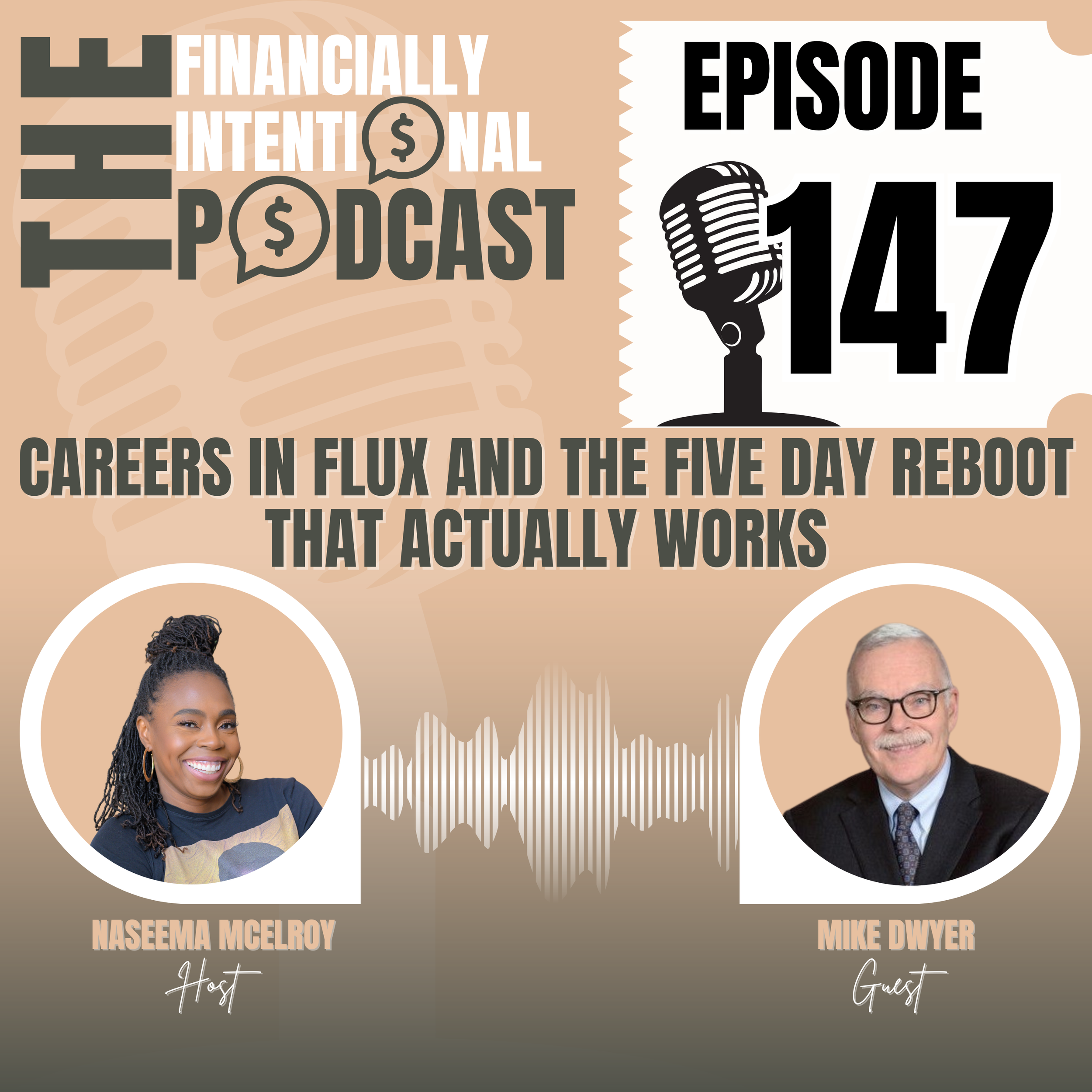
Careers In Flux And The Five Day Reboot That Actually Works - Episode 147
In today's episode I talk with Mike Dwyer about simple steps to find work and grow your career right now. We share an easy plan you can do in five hours or five days or five weeks to build momentum and take more shots on goal. We show how to make a small personal board of three or four people who will give you honest feedback and help you try new things. We also talk about durable skills like telling a clear story and using basic tools, plus ways to explore paid paths like Salesforce training and platforms such as LinkedIn and Upwork.
About our guest:
After a long career in private and public sectors, consulting stints with Ernst & Young and Deloitte Consulting and a Master's Degree in Management from Salve Regina university, Michael Dwyer and a select group of advisors developed Emplana, the career pathway.
Emplana Career, based at Cambridge Innovation Center, 50 Milk Street, Boston, primarily helps seniors discover their next chapter and white-collar professionals, especially in tech, financial services and accounting, law, risk, professional services.
Emplana Career
—-
Please join me here, and follow me on social media, Instagram, and Facebook.
Need help getting started on your path to financial freedom? Start Here
Join the Financially Intentional Community
Oh and please subscribe and leave a review on whatever app you're using to stream this podcast.
Get my book Smart Money

Subscribe & Review
Love this episode? Please subscribe and leave a review on your favorite podcast platform.
TRANSCRIPT:
Naseema: [00:00:00] Mike Dryer works with implant and career services to help countless individuals transitioning in their next career phase, especially those who have navigated decades of change in the workforce now seek renewed purpose. He understands firsthand what it means to have made years of sacrifices only to find the landscape shifting beneath your feet. And he's passionate about sharing practical strategies to harness prior experience for new opportunities.
Mike is deeply involved in building mentorship connections, helping people tap into their authentic network and resources when planning their next steps. His programs are shaped by real conversations with professionals in the thick of transition, giving him a holistic view of the current challenges and possibilities for you.
What's up? My financially intentional people? I am thrilled to be joined today by Mike Dwyer, and we're gonna talk about [00:01:00] careers and transitions and like all those looming things that we see in the headlines around, where our workforce is going. So super excited to bring Mike on because he has some very unique insight and some skills that we could all be learning and things we can all be doing to navigate things, changing times.
So welcome Mike. I really appreciate you being here.
Mike Dwyer: Thank you.
Naseema: Of course. So Mike, let's talk about like how you got into this space, this career space. I know not your main thing, but something that you've been doing for some time.
Mike Dwyer: It is my passion project and I'm lucky enough to have a consulting practice, a day job, if you will. That is mostly just me, but it's well established. I have just hired an intern. I'll be hiring a grad student. So it's an interesting thing. It's very steady.
And it lets me [00:02:00] keep up. I'm doing cloud computing, cybersecurity, a little bit of ai, so for an old guy basically I, I do some advisory work for seniors, and the way I look at it is I never left. So it's not that I've done anything extraordinary, I just continue to show up, but I also offer.
That the way I'm doing things with this incremental sideline, this work I love. That's one of the structures you can do. If you're lucky enough to have a job, then the younger generation calls it income stacking, I don't trust anything anymore and I'm gonna have a freelance and the dog walking business and my creative graphics and wow.
You won't stop me. And I, and I love, that attitude. And as we were talking before we have to recognize that. It's a dire time. You wanna share some of those statistics you mentioned before?
Naseema: Sure. So I was looking at some [00:03:00] statistics because of course across my timeline is the amount of black women that have exited the labor force in the last couple of months. And the most alarming statistic to me was that there are 300 black women that have lost their jobs recently and just in April.
This year, 2025, black women have lost over 106,000 jobs. And then black people make up about 12% of the federal workforce. And we know what's going on with the government and the federal workforce. So just these alarming numbers is like really, really disturbing.
Mike Dwyer: And I am doing a quick flash here of some headlines that I put together, and the purpose of showing this is to be realistic and not to get dispirited. To get determined. Let's not kid ourselves that just throwing a cover letter in and a good resume is gonna [00:04:00] guarantee you something. These days it probably won't.
But, faced with this array of these are wall Street Journal economists. These are mainstream press reports and we don't need to dwell on this too long. Impression made. , You're talking about some great personal demographics. I'm talking about across the board.
We gotta roll up our sleeves here, don't we?
Naseema: Yes. It's scary. It's scary and I look at it like, I'm a nurse, but I'm positioning myself to not be working forever, but I'm thinking about what is a workforce gonna look like for my kids as well? But in the present moment, we just are having some real issues when it comes to.
People finding and keeping stable income.
Mike Dwyer: Absolutely. And I don't want to be the bearer of bad news. The name. You have intentional in the name of what you do, and I overlap with you on that word a hundred [00:05:00] percent. If you just wait I'll see if I get a promotion.
I don't think my company's gonna lay off that's not the right strategy. You wanna be doing things on the personal front and the community front. With your permission, I'll talk a little bit more about those two dynamics, personal and community.
Naseema: Ah, I would love to hear about it.
Mike Dwyer: Thank you. First of all, when I work with people, I try and organize things into a five day time box,
Short.
And if you are really an organized, high speed person, could be five hours. If you are full-time work and doing this at night, maybe it's five weeks, but what I want you to do is start on the beginning, the first time box, the first day. Look back at your career. Look at old emails. Look through files. Look at project notes, and what are you looking for?
You know that human sound we make, huh? We say that's intriguing. Wait a minute. That that could be something we're looking for. [00:06:00] The fact that you actually did a little bit of work in a tax office, or you did some event planning. You're looking for things that are nuggets that you could say. , And you want, you are looking for things to follow up.
People, companies you wanted to track. So this creates, and first of all, I'd say under the heading of mental health, when you're doing concrete steps and you have a game plan, all right, today I'm gonna look through this stuff. Then tomorrow I'm gonna start organizing it into what's my strength and weaknesses?
Do I need to brush up on my tech? Today, you gotta know how to use collaboration tools.
In the work I do, I have to be able to find my way around Slack teams, GoToMeeting, Google Meet, and, but you don't need all that, but you certainly need to be at home and at least one of them.
Where you can say to yourself, oh, I know how to add a document to this environment for others to review.
I know how to respond off hours to something that [00:07:00] came through. So we wanna take a look. So day one, as we are looking back for some nuggets, day two is we're starting to assess what we have and then the fun part comes. We start thinking about our community. And as we were talking before, the idea of putting that personal board together, somebody who knows a lot about your sector, somebody who knows you.
I was working with somebody who's a little bit fiery, who I really admire though, but they come out at you and this person I was talking about, personal board, and she said, yeah, you know what, one of 'em might even not know what you do, but they're gonna be strong enough with you to say that's too timid.
That's a reach for you. You need that feedback. And so if you picture work that says, I'm reflecting on what I've done, I'm assessing what I need in the way of business sector and technology skills, I'm thinking about a community. So I wanna stop for a minute and do a check-in with you. [00:08:00] 'cause now I wanna switch to external and outside world.
So far so good.
Naseema: So far. Excellent. And I just wanted to clarify that this is something that people can do, whether they're in a career transition, whether they're in between jobs or just every day. Every person can do this wherever they're at, right?
Mike Dwyer: That is correct. And you can I think an antidote to the fear and we read these articles about people who have been looking for work for a long time. That's another statistic I'm sure if it's not here, it's, . Nearing our thoughts that it's taken longer to find a job. So I wanna do things that actually create, I'm not a hockey player, but I love their shots on goal concept. And the way they measure 'em is if you've got 40 good shots on goal, right? You are close to the goal. It's a little further away, but it's a high speed slap shot. If you're doing that, you're gonna win.
And that's what we want to do. [00:09:00] So now in this dynamic I'm describing, we've got some reflection going on in our past.
We're looking ahead a little bit now. We're thinking about who we wanna organize into that personal board. How can I buy them some coffee or bagels or get 'em on a Zoom or, and who would be in that group? That old professor you loved? I wanna put something out to people. I have had amazing luck getting back in touch with people on LinkedIn.
After 20 years, if you know somebody pretty good, it's not that hard to pick up and you start off with what you knew about them at the time that you admired, you get a catch up. I've probably done that four or five times in the last few years, and every time it works. So let's go back to this personal board.
That old professor, that person you thought had a lot of good ideas and advice at a couple of companies ago. Maybe a neighbor, maybe their uncle who's got lots of business [00:10:00] experience. However it works for you. And maybe, one of the things. I love when people get real. If you are a gay, black accountant in Oklahoma, you got some navigating to do in our society.
, I regret to say, right? So maybe some of your networking stuff is gonna be around identity and navigation.
Naseema: Mm-hmm.
Mike Dwyer: If you're a 45-year-old financial services professional who's saying, wow, I made money, more money 10 years ago. It's competitive. I don't know this AI and tech stuff. Let's get you on Slack and get a friend and organize a golf tournament or a birthday party.
I want people to go from, what is that to my first impression when I used it is.
And I hope you see the importance of that dynamic from outside to experimentation a little bit. This is what I liked, this is what I need to learn some more. So again, I wanna stop and check in how are we doing? Because to me, this is how I operate, this is what I share with [00:11:00] people. And I'm lucky because I don't need to twist people's arms to be a implant client. I got a day job and I got plenty to do, and I'm working with a university career office and there's plenty going on.
Naseema: Nice. No, I love this. Now, do you think that there needs to be a minimum amount of people, like on this personal board, should you aim to have at least three people? Should it be like that or how do you explain it?
Mike Dwyer: You stole my, no, it's perfect. That's it. That's exactly right. One or two is too small. Three or four is probably manageable. Now you'll read in the business press about a personal port. But I believe, I've told you before in our chat that I've actually convened a group like that and I don't see that too often now harder to schedule little personal risk because if you do get everybody in a room with coffee or in a Zoom call, if you get somebody who knew you were in, in college or grad school and a neighbor and a uncle, there's not much unknown about your left is there.
[00:12:00] You got, you're putting yourself out there and yet. My experience has been that those are the best conversations. They move around. They're utterly tailored to you. You certainly want somebody who knows a lot about the sector you are in or the sector you're interested in.
Naseema: Hmm. Mike, in my personal experience and it's just from having this platform, so outside of nursing, I've just because of the people that I met, just like on podcasts and in other social circles, I have been exposed to opportunities just for myself, not even looking that I didn't even know was possible.
And so I love this board because there's so many ideas and there's so many realms of things that live outside our own personal echo chambers. That we don't even know is out there. So I really love the idea of having this board to like generate ideas because , like you [00:13:00] said, they know you, but also they're bringing in their own perspectives and experiences and community and communities and relationships and all of those things.
And so I think that, that is super to have,
Mike Dwyer: I thank you and we'll have to assure your audience. You and I didn't plan that exchange.
Naseema: Not at all.
Mike Dwyer: This is, this is genuine alignment. , We're, and one of the things I caution people, there are a few techniques I wanna share. One thing is if you know a leading light in a sector and you wanna ask for an informational interview, if you haven't done something like that before.
Don't spend your best card first. Go find someone who's more accessible, maybe not as prestigious or interesting, but could still be good. And someone, 'cause you don't want to take from people, you wanna generally learn from each other. But if you need to ramp up on what's an informational interview [00:14:00] like or what's this personal board, give it a little bit of a dry run,
Naseema: what would like typically somebody want to do an informational interview about?
Mike Dwyer: What they want to know is what's the emerging skills? What do you see happening? And by the way, another technique I wanna share with your listeners is avoid the big ask. If you say to somebody, get me a job, unless it's your brother.
Naseema: Yeah,
Mike Dwyer: Nasima, if I say to you, Hey, what do you see in this sector?
What should I be studying? What are things that are becoming obsolete? Or what are things that are becoming intriguing or whatever? I think that's a flattering question, and I think it's a question that people can comfortably answer, and it's a small ask.
You don't have to do a big commit to share your thoughts about what this person could be looking into or where the sector's going.
Naseema: It's funny I had somebody reach out to me, on my personal finance platform, but with the nursing [00:15:00] question and what I get asked like informational is, I'm a new grad, I wanna get into labor and delivery. What are some things that I should do to get into specialty? And so in that, I think that's a great way to ask.
Okay, you should look into getting these certifications. You should look into what places actually offer new grad programs. Or if there's no new grad programs, how in the hospital do you transition into it? Things like that. So I think like those kind of things are really, really great.
Those kind of questions. I feel like it's not a big ask. Like people aren't like, Hey, can you get me a job in labor and delivery since you've been a labor and delivery nurse? No, I'm not a hiring manager. I can't get you a job, but I can show you how to come prepared for a job and be an excellent candidate.
Mike Dwyer: I love it. And we are so on the same page. It's a delight. Naima. Yeah. And I think that. And what happens is, by the time you do a couple of [00:16:00] those, you're getting a sense of a couple of different hospital systems. Everything from, are you, I know you all so many use that system. Epic. I told you my daughter's a nurse.
Yet there's some others out there and some things. So you get a chance to talk about tech tools, what institutions, what places and another thing too is. The person who put this together with me, Steve, who introduced you and I, Steve Dubin, he is a long time professional networker,
and he and I have actually delivered a professional networking seminar a couple of times.
And,
one of the things he was heard to say recently, I was telling him, , you might wanna real again, your word intentional, if you can find that group, if you're interested in, if you don't know about data analytics and you've read a little and you wanna know more. He finished my sentence. He said, you might drive 75 miles to go to that data analytics meetup.
Exactly. And boy is that [00:17:00] intentional. As you and I talk through this, let's just add a little bit of a concept of a career budget to this.
Naseema: Okay.
Mike Dwyer: All right? You're a financial person, steve Dubin and I argues, he, he's always saying, oh, you gotta be, you should be out there all the time. You know what I mean?
And valid position. Okay, I like it. But yours truly would say, you know what, as little as once every month or two,
Naseema: Mm-hmm.
Mike Dwyer: if you've got eight or 10 things at the end of a year and 16 to 20 at the end of two years. That's life changing. If you've gone to that data analytics, if you've gone to things that are at the intersection of a couple of your interests and heard from people or done, I, I found some people like you.
That is really powerful and that is gonna lead to other things. And again, it's all about shots on goal for a guy who's not a hockey player, I'm just delighted at that concept that , we're really trying to come up with these great shots and really think about [00:18:00] it and make sure that we're doing some effective things.
Naseema: I love this conversation, Mike, because I know that for a lot of people that I deal with when they think about making a career. Transition. They automatically just say, I need to go back to school and get another degree in this. What do you say to that?
Mike Dwyer: That's not where to start. That's, and one of the, one of the things that has, one of these things I flash by you. Goodbye. 165,000 tech jobs, student coders seek work at Chipotle. We told them all if the one thing you could do is if you learn how to code, oh, you can't miss.
Now, it turns out AI is replacing entry level jobs
Naseema: Mm-hmm.
Mike Dwyer: in financial services and technology and programming.
So before you go charging off to. What seems like the right degree, you probably wanna put together that strategy, that [00:19:00] personal board you want to be looking at. You wanna understand your current tools.
Remember I talked about beginning the dynamic. With looking back internal and personal, rough reflection. Then you bring that to your community. You start some conversations going, and here comes the fun part. I've been really looking at gig economy to demographics lately, and I told you before, I work with older people.
Turns out 9% of the Upwork population is boomers.
Now, isn't that a wonderful stat? Because okay, it's not a majority, but you shouldn't feel lonely. What that says to the 60-year-old who's got that I mentioned early event planning or something else. I. You could do something with that and it doesn't cost anything.
And and in fact the same personal board, your community, one of the things you can do that's a small ask, can you gimme a reference? Remember back two jobs ago, [00:20:00] Nasima, when I helped you with that. Could you gimme some kind of little plug or quote? That's not too much to ask. And I hope again, you're seeing where you're exploring Now you're starting to look outside.
I spent yesterday looking through the 750 categories in Fiverr, under. Programming. Now I'm a nerd man. I got a master's degree in management. I hang with accountants, actuaries, attorneys, and this just really gets me going. there's a lot of things you can offer and I'll tell you as a personal story, I have hired people off Upwork and put people on fiber.
Don't hesitate to consider it and you get in with your community, your personal board, get an idea going, get a reference from somebody and put yourself out there at a starting a modest rate. One of the things that's interesting. About these platforms is that you'll see something offering, whether it's project management, ghost writing, proofreading, [00:21:00] you'll see from $10 an hour to 300 an
hour.
Obviously you don't, first time, you don't put out $300 an hour unless you have a pretty serious, certification or whatever. But I think these are great things to all be looking and considering. Now, back to your question about the degree, I think the two major dynamics in career work are networking and skills development, but there are others.
I had a guy come to me 10 or 15 years ago, and I've been knocking around technology since mainframe, and I got my cert from I went to MIT Sloan for a night course, a short course on AI six years ago, just so I could have that cert and wave it around.
So I'm good with all this, so I got a guy who comes to me a number of years ago. And he starts telling me about how he uses these old tools, report writers Crystal report. I can do mainframe access. And I'm saying, okay, there's a place for that there. It's not hot, but we'll [00:22:00] get you something.
But then he goes on to say, oh yeah, but I also love dashboards, Tableau, and all this. So one of the things that's interesting about this dynamic, this back and forth Naima, is. That. Let me help him because you got a barbell story here. You're going back on the one hand to the mainframe, the 20-year-old retro stuff.
Then the other hand, you're telling me today, dashboards Tableau. What we did is we looked out on the job boards and we found things about information analyst that created. An umbrella his elevator pitch, because it had all these disparate parts, you would've ni needed a 90 story building to have his elevator pitch.
But once you put him under information analyst, oh, it made sense. It's easy to talk about. It's, , and it also gave him some things he could study. So that's an example of a dynamic that. [00:23:00] Shows light on what you wanna study. Now one last thought on, on picking some studies. There's a great resource out there.
Used to be called Burning Glass. It's now called Light Cast. Now you know how there's market research, there's the Bureau of Labor right now, the pure labor statistics is all too familiar from the headlines, right? We've got administrations replace the leadership.
What Light Cast does is they have bots that have browsed a billion resumes.
Naseema: Wow. Mm-hmm.
Mike Dwyer: their skills taxonomy, their concept of what's emerging is red hot. And they are, if you're familiar financial person that you are, KKR is rumored to have invested 500 mil in them. So they've got expertise. They've got bots and tech and universities are using them. In fact, the Bureau some of the feds are using them as part of these because they have such a snapshot. So one [00:24:00] of the things you can do now is you can start looking around the world for whether it's the World Economic Forum. They have some wonderful 20 page brochures on what are emerging skills skills taxonomies that even a CEO. They got a skills taxonomy diagram.
This is at the world economic form, so it's legit. As my kids would say, and you can look over these things and one of the things I think is really powerful that comes out of light cast, there's a couple of things I'll throw out for this conversation. The first thing they highlight is intersections.
When the marketing person teaches themselves sequel structured query language, they now. No longer are beholding to an IT organization. There's more self-sufficient, they're more portable, right? We wanna see that stuff. We wanna see these intersections. Another thing that light cast taught me as a concept is the [00:25:00] idea of a lifeboat job.
Yesterday I got a LinkedIn from Intuit saying, as a tax professional, we wanna know how, I don't know how they, I've got some financial background. I went to grad school, but I'm not a tax preparer. But one of the things that Light Cast does is it talks about lifeboat jobs. 90, I'm in trouble.
A tax preparer is something that doesn't take a graduate degree to get underway, and I think people use that personal board, their community and their research to be looking for things that have a shorter on-ramp but lead to some income. I love that example of, it's a great concept. have to be honest with ourselves.
I need a lifeboat. Okay. Somebody actually come up with that concept who works on labor data. They actually have an example and let's go find some more of those. That'd be some great work.
Naseema: I was looking at like hassle that they have some amazing data.
Mike Dwyer: Yes.
Naseema: I, I'm just like, personally like looking at it because I have friends that [00:26:00] have platforms that they're building out to compare nursing salaries across the world and I'm like, I'm gonna put them onto that 'cause they have some good information.
But yeah, I think that a lot of people just don't understand what's out there and like truly how to pivot when to pivot. And just how to do it as efficiently as possible. I have a friend that's a Salesforce administrator. He's a Salesforce consultant, and he was telling me, Salesforce, obviously I'm in the Bay Area, has the biggest.
Tower in San Francisco, and most people don't even know what Salesforce is because it's been in the background of everything. So it's not a sexy job. But they have so many jobs within that ecosystem that you can access and they train you for free. So they, like Salesforce will train you to be a Salesforce administrator for free.
Like the minimum requirements are that you're like. I don't know. You don't even have to be 18, but you [00:27:00] don't have to have a high school diploma. You don't have to have anything. But a lot of people can go through that and then start a new career in six months and, be making, out of your first year, like 75,000 to a hundred thousand in your second year.
I love talking about these things because they're not like those big sexy things that people, everybody wants to be a content creator, a YouTube creator, like all these things like now, right? That you take just a little bit of effort and a little bit of intentionality training. Those things that you already know and there's different areas you can work in based off of what your skillset is, but just I love that.
I love this example. I love this resource that you have, but I just want to shed light on there's so many different things that do not take a lot of effort or a whole lot of student loans to transition into.
Mike Dwyer: I love it. And in fact I brought up the concept of a lifeboat. You brought up something, a ship I think I could stay on,[00:28:00]
Naseema: Yeah. Yes.
Mike Dwyer: But I hope your listeners can hear. What happens when you do active collaboration with people that have some knowledge about the sector who care about these things and who work on them?
, It can make a big difference and it can have results and.
Naseema: Yeah. I think the biggest theme here is that there are so many things that you can focus on. That are negative and AI is taking all of our jobs and we're facing massive layoffs and government shutdowns. There's so much noise out there. But if you pull in and look into what your skills are and what your, who your network is you will.
Never run out of opportunities to make an income. And I always tell my kids this, and my kids are little by the way, so it's, two, you saw one, but I have two, six and 11 year olds, and I always tell them, if you could solve a problem for someone, you will [00:29:00] never run outta ways to make money.
Mike Dwyer: I love that , an entrepreneur I admire very much as a professional services accounting firm with people all across the us Small, but. Impressive. She mentioned that recently at a conference. She heard they weren't soft skills. They're durable skills, and I love that because I think, like I gave the example before of when the marketeer learns structured query language, sequel, but I also think I've seen some great stuff on LinkedIn that says, Hey, AI or tech.
Learn how to tell a story. And I think these conversations, you and I having, these explorations, that's what leads you to something that says that, remember that sound I mentioned to you? I, the sound I want when I work people is, huh?
Naseema: Hmm.
Mike Dwyer: Huh? That, let me look at that. One of the things as I'm such a nerd a few years ago I wasn't able to attend it, but I'm an associate [00:30:00] member of IEEE, the electrical engineers.
I'm not an electrical engineer, cost me 200 bucks a year. But you know what? If I wanna know about something, I'm not getting a vendor white paper. I'm downloading. First class content, and I wanna bring that to your, whoever you are, whether you're a people person, whether you're the front office at Salesforce or the back office know who you are.
One of the things I'd say about today is whether it's additive printing. Drones. What I mentioned about IEEE, I wasn't able, I've attended some things on robotics that were stunning, but I wasn't able to go to the one on drones. But it was a two day thing up in Maine
what day one was we're gonna teach you how to build and fly a drone, and day two was regulations, FA, and how to be like a responsible and confident.
Droner now back here in the home front. It turns out a few years ago, the wife bought [00:31:00] me a pretty good drone, like just into the level where you could use it for a tool or something, and I just so busy. I let it dust, get dusty for a couple years and I got really mad at myself. I went and watched some YouTubes and I got going and it turns out it is.
Really interesting. And as soon as I showed a friend a picture of my yard, my wife's hydrangeas, my friend at church said, could you take a picture of my next social gathering?
Naseema: Yes,
Mike Dwyer: Ah. And so from my most recent. And so from my most recent birthday, the wife got me two slim books. One is a book on drone photography.
Make sure you have scale, get a signpost or a human. Oh, okay. That's a good idea. But the other one were these drone business ideas that, you know, whether you're painting parking lots, so depending where you're. Remember earlier on, I counted on you being a financial person and used the concept of [00:32:00] portfolio.
So if you are 25 years old, you want to be in equities and only a little bit in fixed assets, right? But if you're 65 years old, you don't want much market risk. That's how it is. One of the things you can do in your career work is something similar. You can say, I'm gonna chase that wonderful opportunity at Salesforce, but you know what?
I wanna have another horse in the game. I wanna have another chip on the table. And I'm gonna start exploring whether it's a craft business on Etsy. Somebody, I was in one of these wonderful podcasts and they said. Could you apply these same things to Etsy? I don't know anything about Etsy, but I'm sure you could network, you could figure out, you could get an informational interview.
You could figure out what would be the thing you would offer and all the stories. You and I have told in the last minutes what I think still make a lot of sense, even in this new neighborhood.
Naseema: Yeah, I love that. Even, why we're [00:33:00] here, right? I'm a labor and delivery nurse. I had a problem with my finances. I sought to solve that problem. It turned into me creating this platform, which turned into me creating a podcast and all of the things that I've learned in building a social media platform, marketing.
All this stuff, running the back end of a business, building community, learning how to do a podcast, all of these things on top of all the other certifications and everything that I have and degrees that I have from being a nurse. All of these things are marketable skills that I have been asked to do like a number of things for.
I've been hired by FinTech companies to build out their communities, and so like I, I love these examples and I love like. Talking through these things and brainstorming because again, a lot of people get caught in like the negative news cycles and all these kind of things instead of [00:34:00] having these conversations with each other so that we know what's out there and what's possible.
Did you do your whole framework, Mike, or you got some more?
Mike Dwyer: That's probably I actually have a book that I am, I'm revisiting. I think we touched on the really big moving parts. Ms. And I, and I really thank you for letting me share this with the audience. But what I really thank you for is jumping in with stuff so aligned with content and thought so aligned that it looks like we rehearsed.
Good job you. It's
Naseema: This was not planned. It is just, when there's alignment, and I just think this is just a really timely conversation and I just think it's really important for people to hear this and probably have to listen to it again, especially if you weren't ready to hear this, but it's what everybody needs to hear right now.
I think this is. So timely just because of all the negativity and all the crazy things that we hear in the news [00:35:00] cycle, and then on social media and all these kind of things. It just puts you back to where you're at right now, what you have going for you and what you have to offer the world.
And I think. All of us have so many amazing things, but we just don't know how to tap into that. And I think you gave some really great examples of how to do that inwardly and through your network, and I think it's just really, really important to hear. So no, we did not rehearse this. No, I did not even know that that is like how deep the conversation was gonna go, but it just shows like how important this is.
And I really just think I, I love the work that you're doing, and so I just, want people to understand if they wanna work with you, like what you offer, how you work with people.
Mike Dwyer: Thank you. And, but it is my delight that there's no hard sell here. Sent, there's a submit form on imp plana career.com, but [00:36:00] I'm actually enjoying doing, I, so I mentioned before, I work with the university career office. I do job shadowing, mentoring. I do some informal, I paid unpaid. But it's, I just love these conversations.
Nancy, man, you have fit in beautifully. I wanna leave or I have this feeling we're getting to a natural closing point. And I wanna offer you something that supports what you and I have been talking about. I did a marketing study about 10 years ago that I paid for my own pocket, actual Mike dollars, so I cared about.
And one of the things that came out of, it was a top Boston marketing strategy firm, and I had 'em look at career and they they did some great work at what? Looking at the marketplace segmentation, it really got me thoughtful about the age cohorts. I work with all those things, but they ran a couple of informal focus groups and there was a result that come out of that I wanna share with you and your listeners.
Naseema: Mm-hmm.
Mike Dwyer: Basically what came [00:37:00] up, it didn't come up in this order, but when we're said and done, when you wrote up the final, basically what a couple of different focus groups said was, when you wanna get in shape, new Year's, you join the gym like everyone does.
Naseema: Yeah.
Mike Dwyer: Everybody expects to hire a trainer to get in shape, but somehow when they're thinking about career and job, I need to be the Marlboro man, if I need to be the strong, silent type. And to me that is absolutely backward. I wanna do everything I can to say don't do that. And all these great examples. And so I offer that as a context for all the great examples you and I have touched on where. Working with others. Let's say you say, look at all the opportunities you've got by just creating momentum,
finding people, having a network that's just a good move.
Naseema: Yeah. I love that. And like when people typically come to you, at what point are they at? Are [00:38:00] they in their career trying to transition? Are they looking for jobs? Is it just like across the board? Who do you
Mike Dwyer: Across the board. And wow, one of the things I live at a co-working space with somebody in the Bay Area is, is gonna understand. And I mean there's 300 companies and there's just an absolute array of nonprofits for profits and stuff. So I get so many kinds of leads and conversation and the out of that.
Naseema: Mm-hmm.
Mike Dwyer: Remember I mentioned about the marketing strategy firm? Both they and a really smart person in my circle had me take a look at age in people I work with.
And here's what shaped up Nasima. Turns out you get your first interest at about 10 years in the 30 year. They got their feet under them. They're either feeling okay, I've done this.
I want to reach, or hmm, I, I, I know the landscape now. I watch companies consolidate whether it's positive or negative. There's typically some interest around there.
Naseema: Mm-hmm.
Mike Dwyer: again, we see [00:39:00] things in the 45 to 50-year-old where this is where a lot of times it's a bit negative. It's, wow, I'm not sure I'm keeping up.
It's more competitive. I literally have had multiple people in financial services tell me I made more money 10 years ago. So you want, we wanna work on that. And then the other cohort that I've been, Steve and I have been really focusing on lately are the seniors. And, I'm not above saying, don't be telling war stories.
Come on, stay focused. look at that reflection I described, finding those nuggets. Use those. And figure out how your job is to get a little community together to figure out how you can leverage that experience without just being a bunch of anecdotes and war stories and back when I was doing it.
No, that's not what's gonna work. What you're gonna, you need to take that and look out on those job boards, but that's why that 9% of Upwork being boomers is such a critical statistics. But I hope you're hearing [00:40:00] that this is a. Take all comers. You know you're gonna do it your own way with the right cohort for your age group and experience and sector.
But make sure you put a little community together and make sure there's at least some exploration of something you don't now know about. Whether it's the drones, the 3D printing. The things you discussed, I love, those are, like you say, the tell the people, go back and listen a second time and you ticked off social media, this, that, and the other.
Those are great things and those can certainly lead to work.
Naseema: Yes, yes. Okay, so how can people work with you?
Mike Dwyer: Very easy, just go to and plan a career.com and fill in the little submit contact us and one of us, me or a grad student or somebody to get back to you. But I hope really the purpose of doing these podcasts is not that I'm trying to drive sales, but instead that it gives me a chance to work with someone like you [00:41:00] and have this kind of a discussion where we're exploring, sharing, and supporting your listeners.
And that to me is just so cool.
Naseema: And I know my listeners will definitely appreciate this. 'cause like I said, I think this is a very timely conversation to have.
Mike Dwyer: so thank you. And by all means get in touch, but I'd also say you might not need to, if you think through this, like you said, listen to the second time and start putting some things in play. You, you might find that path shows up and, but above all, the beauty of intentional is momentum.
Naseema: Mm-hmm.
Mike Dwyer: You're not just taking it about the head and shoulders, you're saying This is what I'm going for.
And that to me is healthy. And remember the thing is, will it result in a shot on goal? That's how we'll
Naseema: Right, exactly. I love that analogy. I've never heard it before, but I'm definitely gonna start using that. It's not about hitting the target, it's really about all those shots that you take. And I like to [00:42:00] say it's the aggregation of marginal gains, those little things that you do every day that really make a difference.
Mike Dwyer: That is a beautiful expression. We're gonna share expressions with each other. Naima.
Naseema: Yes. Yes.
Mike Dwyer: If I can throw one last Mike Deism at you. This is one I made up on my own. Do you know why meetings are like microwave popcorn?
Naseema: Why?
Mike Dwyer: First it goes pop, pop, pop. Then it goes quiet a little bit and then you burn it.
And so you wanna know when it's kinda popped most of the kernels and done what you're trying to do, and then maybe it's time to move to adjourn. What do you say?
Naseema: I love it. We're not burning a popcorn here though, Mike. I think we're still hot. So
Mike Dwyer: All right. Well.
Naseema: you.
Mike Dwyer: Thank you and iu, thank you so much for such a great conversation and for sharing your world and your audience with me.
Naseema: I really appreciate you.

Hey there I’m Naseema
My dream is for everyone to know that financial independence is attainable with a little intentionality. Learn how I can help you finally break the cycle of living paycheck to paycheck.
Join the Facebook Community
Join the Financially Intentional community and get access to resources to guide you on the path to Financial Freedom.
Watch these Videos To Learn How to…
Keep Listening
Here are some more episodes you may enjoy…







We break down what’s really happening with hormones, metabolism, and aging in a simple way, including why perimenopause can sneak up on you.